Jaecoo 7 2026 review | Runaway success for a very mediocre Chinese SUV
Jaecoo 7 cars for sale
3.0
Expert review
Pros
Genuinely impressive cabin quality
Roomy and practical
Lots of car and kit for the money
Cons
Petrol-only powertrains unpolished
Intrusive driver assistance features
Some ergonomic oversights
The CarGurus verdict
Looked at objectively, there’s a vast amount to like about the Jaecoo 7. It’s a good looking family SUV with lots of interior space and practicality, and you get an impressively high-quality, premium-feel interior that comes absolutely packed with standard luxury- and safety equipment, and all for an impressively low price.
Yes, we’ve also identified some fairly fundamental flaws, such as the unsettling all-or-nothing power delivery of the non-hybrid models, and the intrusively unpolished operation of some of the semi-autonomous driver assistance systems. It's also a very mediocre car to drive generally, and though not the worst we've seen, the infotainment system could do with being a bit less user-hostile, too. Still, the sales figures show that these shortcomings don't seem to bother many British buyers looking for a bargain, and it might well be that they don't botther you, either.

What is the Jaecoo 7?
When the Jaecoo brand first launched in the UK in January of 2025, it was something of an oddity. Here was an obscure new Chinese marque that nobody had ever heard of, with a comically odd name (it is, so says the firm, a contraction of the word ‘Jaeger’, the German word for ‘hunter’, and the English word ‘cool’, so if you for some reason consider yourself to be a ‘cool hunter’, it could well be the brand for you) and precisely zero brand recognition.
It was Jaecoo that would have the last laugh, though, because despite these perceived obstacles, it wasn't long before the Jaecoo 7, the brand's inaugural SUV offering in the UK, was rocketing up the new-car sales charts. What's more, that trajectory has continued accelerated, to the point where, out of nowhere, the 7 is now one of the very best-selling cars in the UK.
But precisely where has this brand and this car come from? Well, Jaecoo, along with sister brand Omoda, which launched a few months before (the Omoda 5 SUV was launched in August 2024), are both owned and operated by Chinese automotive company Chery International. And this certainly is not Chery’s first rodeo, not by a long shot. The firm has been going since 1997, giving it more than a couple of decades of experience in building cars, and more than 20 million of them have been sold along the way. And since launching Omoda and Jaecoo to the UK market, Chery International certainly hasn't rested on its laurels. These two aspirational brands have been joined by a third more mainstream brand known simply as Chery, while a new luxury brand called Lepas is just around the corner.
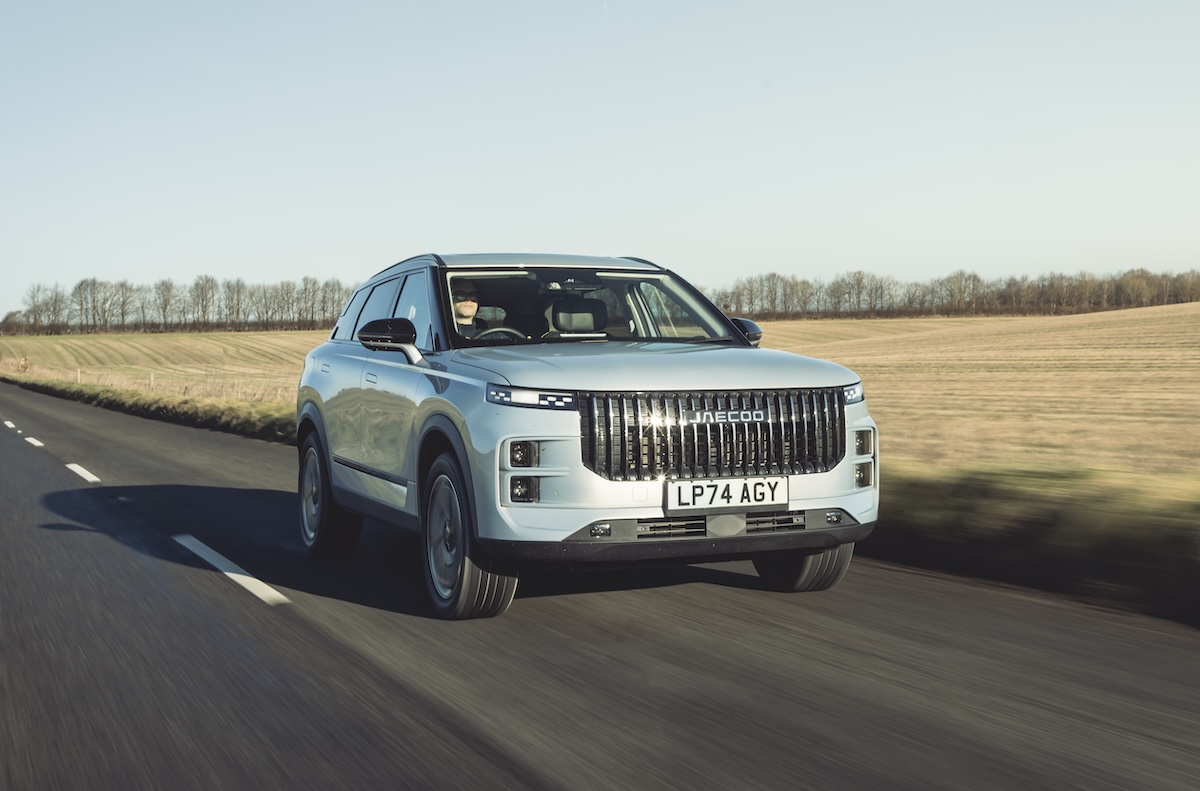
The Jaecoo brand identifies as a kind of rugged, off-road marque with a prestige twist, in a similar way to how many might see Land Rover or Range Rover. And there’s certainly more than a hint of those brands in the design of the Jaecoo 7: the chunky details and swept-back windscreen give off strong Range Rover Evoque vibes, as do the tapering roofline and the narrowing glass area towards the back of the car. And as for the electrically retracting door handles that disappear into the bodywork...
In terms of size, the Jaecoo 7 (it’s called the Jaecoo J7 in some other foreign export markets) is a five-seater SUV that sits bang-on halfway between a Range Rover Evoque and Velar in size. Its footprint is actually very similar to that of a Hyundai Tucson, which will probably be considered a more direct rival, not least because the Jaecoo sits far closer to the Hyundai on price. That means you can also factor in any number of similarly-sized midsize SUV rivals to your buying decision, of which there are plenty. The brand would like you to think of the 7 as a premium SUV contender to rival the likes of Audi and BMW, but at a price more comparable to Hyundai or Kia.
And that's been pretty much key to the Jaecoo 7's vast success so far. It offers bags of style and standard luxury equipment, not to mention a high-quality interior and a long warranty, for a price that undercuts pretty much every rival by thousands.

How practical is it?
One of the slightly strange things about the Jaecoo 7 is that you get a completely different interior look depending on whether you go for a pure-petrol car or the hybrid. In the petrols, you’ll find a chunky aircraft-style gear selector and a rotary drive mode selector on the centre console, and door cards with robust grab handles with a collection of conventional window switches and buttons for adjusting your electric mirrors. The PHEV, meanwhile, is intended to have a more minimal EV-esque environment. The drive selector is moved to the steering column for a cleaner-looking centre console, while the window switches are swapped with more futuristic-looking toggle-type items (which, incidentally, work the opposite way round to what’s intuitive). Either way, you get some handy storage beneath the central armrest.
And, either way, you can’t fail to be impressed by the quality of the interior. Yes, there’s more than a hint of Range Rover to the interior design, but don’t be under any illusion that this is some cheap knock-off. The materials used are dense, plush and tactile, giving a really high-end, premium feel to the car, and the thoughtfully chosen selection of textures and finishes on display makes the interior feel interesting and attractive, too. The strips of ambient lighting dotted around help that feeling, and the colour of these can be customised almost infinitely through the central touchscreen.
Nestle yourself into the supportive driver’s seat, and you’ll find lots of powered seat adjustment, sufficient manual steering wheel adjustment, and a clear forward view. A small rear window means your rear-view isn’t quite so clear, but that’s no surprise given the swoopy design of the rear end. And of course, there’s ample space in the front seats.
Happily, there’s also ample space in the rear seats. Despite that swoopy roof design, even tall rear-seat passengers won’t be short of headroom, and there’s also really generous rear legroom, allowing passenger room to spread themselves out. It’s very comfortable for two rear passengers, and a third passenger squeezed in between will be fine for short journeys, too, thanks to a relatively wide middle seat and a rear footwell that’s almost flat. However, the cabin isn’t quite wide enough that there’s sufficient shoulder room to allow three to travel in the back comfortably for long periods. That’s no massive slight on the car, though, as it’s the norm in this class.
The other thing that differs slightly according to your powertrain is boot space, and how your space is arranged. In the front-wheel-drive car, you get a very competitive 500-litre boot capacity, but the low-slung load floor means there’s a lip of a couple of inches at the entrance of the boot, and when you drop the 60/40 split-folding rear seats, there’s also a small step up to the folded backrest (they also lie at a slight angle, leaving your extended loadbay with a slight slope).
Choose the 4WD or the plug-in hybrid car, and the extra mechanical gubbins that they need to carry means that the boot floor is positioned higher up, and sits flush and level with both the boot lip and the folded rear seats. You get a fraction less space as a result, with a figure of 412 litres, but the way the space is packaged makes it arguably more user-friendly.

What’s it like to drive?
When the Jaecoo 7 was initialy launched, there are three powertrain options offered, and we got to try all of them. The first two revolved around the same turbocharged 1.6-litre petrol engine, paired with a seven-speed dual-clutch automatic gearbox. You get 145bhp in both, but the difference is that one comes with front-wheel drive and the other has four-wheel drive. The former will do the 0-62mph sprint in 10.3 seconds, while the slightly heavier all-wheel-drive car takes a little longer at 11.8 seconds. Pace is generally adequate-but-modest, then, but it’s the way the power is delivered that most captures the attention. And in the cars we experienced during our test drive, not in a good way, unfortunately.
In both, you have a fly-by-wire throttle that’s very slow to respond, and also very difficult to modulate accurately. Meanwhile, you also have an automatic gearbox that’s slow to engage at a standstill and slow to react on the move, and the transmission is also very keen to kick down without too much provocation. The overall effect of all these various factors is that when you squeeze the throttle pedal, very little happens initially in the way of speed-building. So, you push the pedal a little further - and we’re talking millimetres here - and then all of a sudden, the gearbox kicks down, the engine revs soar (causing it to drone away noisily), and you surge forwards considerably faster than you intended. And, this all-or-nothing power delivery applies whether you’re pulling away from the mark or building speed on the move. It feels jerky and clumsy in the four-wheel-drive car, but in the front-wheel-drive car, things are exacerbated further by the fact that when the surge of power finally does arrive, it often spins up the front wheels. We say ‘often’: it does this on a very regular basis, and if it happens mid-corner, things can feel quite hairy.
To be fair, these issues felt to us like they were caused by unpolished software for the gearbox and fly-by-wire throttle, rather than any fundamental shortcomings with the mechanicals used. And because the car supports over-the-air updates for such things then, assuming that Jaecoo’s boffins can polish up the sloppy software to get things working more smoothly, improvements can in theory be rolled out automatically without owners having to visit a dealer. However, we haven't had a go in this car since our initial experience, so we can't tell you whether that's been done yet, successfully or otherwise.
The other powertrain available from launch is a plug-in hybrid - dubbed as SHS by Jaecoo - that combines a 1.5-litre turbocharged petrol engine with a couple of electric motors to deliver a total of 201bhp to the front wheels. Stat fans might like to know that it’ll do the 0-62mph dash in 8.5 seconds, and that on a full charge of the battery, it has an electric-only range of up to 56 miles according to official WLTP figures.
The interesting thing about it, though, is what happens when the plug-in power is gone. With many plug-in hybrids, things are fine and dandy when you have juice in your battery, but when that juice runs dry, the petrol engine gets no help and it has to haul around the extra weight of the batteries and motors, making it thirsty. With the SHS, says Jaecoo, the battery is never allowed to fully deplete while there’s petrol in the tank, with the engine and regenerative braking topping up the power levels as you go. This means that once the majority of your plug-in power is gone, there’s still enough power in the battery for the car to effectively operate like a self-charging hybrid, so the motors are always on hand to help out with the propulsion effort, making things more efficient.
In terms of sensation, the PHEV doesn’t ultimately feel much quicker than the other versions, with performance remaining at an adequate-but-modest level. However, your progress is a good bit smoother, with a more consistent and more predictable power delivery than the all-or-nothing experience of the other versions. It’s also a good bit quieter: because the electric motors are on hand to take on some of the heavy lifting, the engine doesn’t have to work as hard and the revs aren’t sent up to the redline on a regular basis.
And the rest of the driving experience? Well, the ride is certainly on the firm side, so things can get rather jittery and unsettled on a particularly scruffy surface, but comfort levels are just about okay most of the time. Body movements are reasonably well tied down, so things don’t feel unduly floaty over undulations and there’s not too much body roll as you change direction. However, the steering has rather slow initial responses and is very short on feel. As an overall driving experience, it's just about adequate, but if you're looking for the dynamic polish you get from a European of Japanese rival, you won't find it here.
Later on, another powertrain was added to the range and self-charging hybrid dubbed as SHS-H. This deliver 221bhp to the front wheels for a 0-62mph sprint time of 8.3 seconds, but we haven't tried it yet, so we can't tell you what it's like.

Technology, equipment and infotainment
The front-wheel-drive version of the Jaecoo 7 comes exclusively in Deluxe trim, while the all-wheel-drive version and the plug-in hybrid both come exclusively in Luxury trim. In truth, both are fantastically well equipped, especially given the price you pay.
For example, Deluxe cars come with 19-inch alloy wheels, privacy glass, automatic full-beam LED headlights, a full-length panoramic sunroof, synthetic leather upholstery, heated front seats, powered front seat adjustment, front-and rear parking sensors, a 540-degree surround-view camera (more on this in the ‘Three things to know’ section), adaptive cruise control, dual-zone air-conditioning, a powered tailgate, and automatic wipers. Your standard equipment roster also includes a vast array of airbags and semi-autonomous driver assistance systems, including adaptive cruise control, automatic emergency braking, blind spot detection, and forward collision warning (there’s more on a few of these systems in the ‘Three things to know’ section as well).
On top of that, Luxury trim comes with an air purification system, head-up display, a heated steering wheel, heated outer rear seats, and ventilated front seats with lumbar support and a welcome function (they move out of your way to make getting in easier, and then return you to your driving position once you’re in).
The nature of the infotainment system varies according to trim level, too. Both have a large portrait-orientated touchscreen in the centre of the dashboard, but this is a 13.2-inch screen in Deluxe trim and a 14.8-inch one in Luxury trim. Luxury trim also gets an upgraded Sony sound system with an additional pair of stereo speakers, totalling eight compared to the Deluxe’s six.
That aside, both systems provide pretty much the same level of functionality including DAB, Bluetooth, native satnav, wireless phone charging, wireless Android Auto and Apple CarPlay, and four USBs (two front, two rear). All versions also come with a 10.25-inch LCD display behind the steering wheel to deliver all the important driving information, and this can be configured in a choice of layouts.
In terms of the system’s user interface, we’ve seen better, but we’ve certainly seen worse. A couple of the submenus are very long and convoluted, and there’s very little visual differentiation between the various options (you’re essentially faced with a long list of on-or-off checkboxes), but most of the menus are short-and-sweet enough so as not to be utterly bamboozling, and you can generally find your way around fairly effectively once you become accustomed to the system. As ever, we’d prefer it if there were physical air-con controls rather than yet another touchscreen menu, but those are increasingly becoming a thing of the past these days.

Jaecoo 7 running costs
Purchase prices are one of the Jaecoo 7’s big appealing factors. Prices start at around £30,000 for the base-level petrol version, rising to around £34,000 for the higher spec petrol and topping out at around £37,000 for the range-topping plug-in hybrid. That undercuts the equivalent Hyundai Tucson by a very useful amount.
Do bear in mind, though, that fuel returns likely won’t be as good on the petrol versions. The front-wheel-drive car has an official WLTP figure of 37.7mpg, while the AWD version drops that return to 35.3mpg. In the equivalent Tucson, you get upwards of 40mpg according to the official figures.
The SHS plug-in hybrid version has an 18.3kWh battery pack, making it capable of an all-electric range of up to 56 miles, according to WLTP figures. That helps towards a combined fuel economy figure of 403mpg, which is considerably better than the 282mpg you get from the plug-in hybrid version of the Tucson. With both cars, though, be aware that these figures are next-to-useless because the official laboratory tests are unrealistically flattering to plug-in hybrids, so you’re unlikely to get anywhere near that in the real world. For best effect, keep your battery topped up so that as much of your driving as possible can be done on electric-only power.
When topping up the electricity in your PHEV, AC charging takes place at a maximum speed of just 3.3kW, and at that speed, a full charge takes around six and a half hours. DC fast charging can be done at a maximum of 40kW, which at the right sort of charger, will deliver a 30% to 80% top-up in 40 minutes.
We haven't yet seen fuel economy figures for the self-charging hybrid variant introduced later down the line.

Jaecoo 7 reliability
It’s always notoriously difficult to pre-judge the reliability of any brand new model when it first goes on sale, due to a lack of data. However, when that brand new model is also from a brand new, er, brand, you’ve got even less data to go on.
You can, however, take confidence from the fact that the Jaecoo 7 comes with a warranty package to rival some of the best in the business. It has a Kia-matching seven-year, 100,000-mile arrangement, with the first three years having no mileage limit.
Initially, we urged a bit of caution here, because the warranty package wasn't all that it seemed. An abnormally long list of warranty exceptions in the Ts & Cs meant that certain componets and systems quietly fell off the warranty cover after just three years or 40,000 miles, and many of the items on this list were key componements that would be very pricey to fix or replace in the event of trouble, potentially leaving customers with a big bill when they thought they would probably be covered.
However, we're pleased to report that after feedback from customers and dealers - not to mention a vast amount of moaning from us here at CarGurus - Jaecoo has now amended its cover so that the vast majority of those components are now covered for the full advertised term of the warranty, and the few that still aren't a covered for much longer than they were. That extended cover also applies to cars bought before that change was made in August 2026. We applaud Jaecoo for taking action on this issue.
- Like all modern cars, the Jaecoo 7 is fitted with a vast variety of driver assistance systems which, to comply with legislation, are always activated automatically when the car is turned on. Once fired up, though, a simple downwards swipe on the central touchscreen brings a set of on-screen tiles that quickly and easily allow you to disable some of the functions that might irritate you. Not that we advocate the habitual disabling of potentially helpful safety systems, but having this choice is a positive thing. After all, nobody wants to get bonged at every time they cross a white line.
- In fact, those white lines can cause you a few more issues than just bonging in the Jaecoo. You see, as part of the car’s suite of ADAS features, there are a variety of lane regulation systems, including lane departure prevention and emergency lane keeping assist. These essentially apply steering effort to the wheel automatically to steer you back into your lane if the car thinks you’re wandering around too much. However, the system isn’t great at keeping the car in the centre of the lane, and when you try to correct the car’s line yourself, the steering effort being applied automatically means that applying your own steering effort takes much more strength than it usually does. It’s a bit like driving a car that’s fighting back. And even when you think you’ve disabled these systems on the central screen, they’re automatically reinstated if you hit the button on the steering wheel (intentionally or accidentally) that activates the adaptive cruise control. All in all, this is another area in which we think Jaecoo could do with polishing up its software and issuing an over-the-air update.
- There’s another oddity we noticed with how the Jaecoo 7 operates when rolling along. It has a really clever 540-degree parking camera with a ‘Transparent Chassis’ function. This basically takes images from a number of different cameras around the car, and underneath it as well, and stitches them all together to give you a detailed view all around the car, and underneath it, too. It’s a really useful feature in the right circumstances, and those circumstances aren’t merely limited to spotting undertray-bending rocks when off-roading. However, this view is offered up far too often on your central screen. You’ll find that you’ll be rolling along, following the instructions of your satnav, but as soon as you need to make a turn and start signalling with your indicators, your entire central screen immediately becomes entirely occupied by this view, completely taking out your satnav instructions and making you unsure of where you’re supposed to be going. If you need to make a couple of turns in quick succession, you’ll have no idea which way you’re supposed to steer.
- If you want to keep your purchase price as low as possible: You’ll probably want to stick with the entry-level front-wheel-drive car with the petrol-only powertrain. It has the same power output as the four-wheel-drive version (it’s actually slightly quicker against the stopwatch due to its reduced weight), it comes with very nearly as much standard equipment and it looks just as good, yet it costs you a good few grand less to buy, starting at around £30,000.
- If you plan to tackle the rough stuff: Then you’ll probably want the four-wheel-drive version. Jaecoo sees itself as an off-road-ready brand, and the 4WD car has a variety of off-roading modes to help tackle tough terrain, but we’ve not had a chance to put these to the test yet.
- If you want the best fuel economy: You’ll want the SHS plug-in hybrid, and not just because its electric-only range of 56 miles gives it a WLTP combined figure of 403mpg. No, it’s also because once your plug-in charge has been used, the system operates like a self-charging hybrid, so it’ll likely still be considerably more efficient than its pure-petrol counterparts.
- If you want the best-driving version: based on what we’ve experienced so far, you’ll want the hybrid, which has a smooth, easy-going nature. The pure-petrol variants we’ve driven, meanwhile, have an all-or-nothing power delivery that can get quite wearing.


