Peugeot 408 2026 review | Striking and practical five-door hatchback

Pros and cons
What we like
Unconventionally stylish looks
High-quality interior
Strong on practicality
What to consider
Driving position can be hit and miss
Rear visibility is terrible
Steering can feel twitchy
The CarGurus verdict
The Peugeot 408 is a very compelling car, but its real appeal lies in the fact that it is refreshingly different from the norm in terms of its styling and body shape. That in itself is a unique selling point that will rightfully earn it plenty of buyers. But as with its Citroen C5 X sibling, the Peugeot can be quite hard to justify in purely objective terms. Other cars at this price offer more rear headroom and easier access to the back seats, while conventional estates such as the BMW 3 Series Touring, Vauxhall Astra Sports Tourer and Peugeot 308 SW all provide more luggage space. The same goes for conventional family SUVs like the Peugeot 3008 and Nissan Qashqai.
Peugeot itself states that its brand is all about ‘allure’. Well, the 408 is more alluring than most of its other models. If you like the way it looks, and you want a car that is comfortable, relaxing and can be fun to drive on the right road – and you are happy with the practicality compromises – you will love it. With a wider range of electrified powertrains now available, including the plug-in hybrid and EV, the 408 makes more sense than ever.
out of 5 expert review
What is the Peugeot 408?
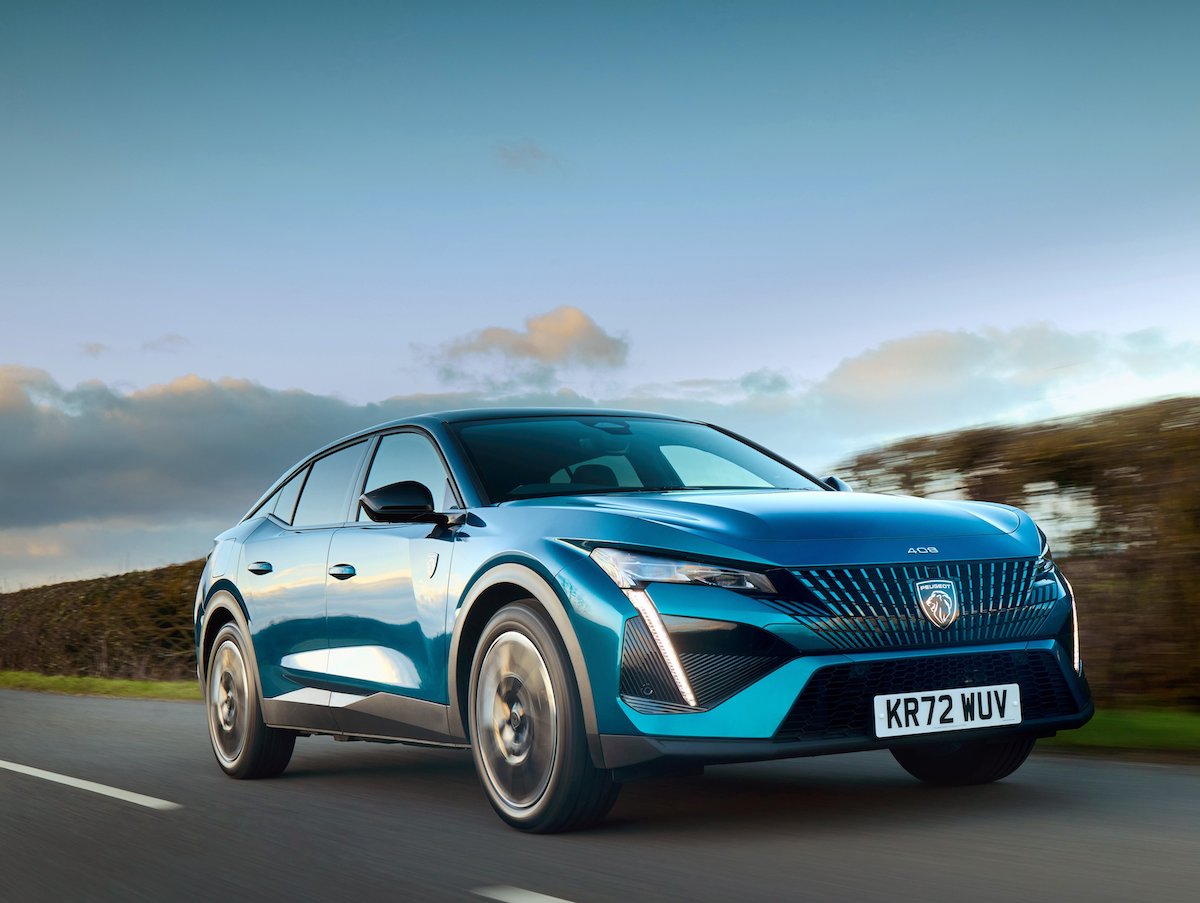
The Peugeot 408 is the French manufacturer’s offering in the mid-sized family car class, blending elements of crossover, coupe, hatchback and saloon within its black-plastic-clad, swooping fastback design.
Style is one of the Peugeot 408’s key selling points. It boasts a sleek and angular design, complete with a distinctive grille and LED running lights. Make no mistake: the 408 really does stand out from the crowd. Rivals include everything from family hatchbacks such as the Volkswagen Golf, Renault Megane and Skoda Octavia, to family SUVs like the BMW X1, MG ZS EV and Peugeot’s own 3008.
The range of powertrains has evolved since launch. The entry-level version is now the Hybrid 145 mild-hybrid petrol, while electrified options include the Plug-in Hybrid 225 and the fully electric e-408, which uses a 58kWh battery and 207bhp electric motor. Early plug-in hybrid versions offered between 37 and 42 miles of electric-only range, while the current Plug-in Hybrid manages an impressive 57-60 miles according to official figures.
Prices vary depending on trim and powertrain, but high-spec versions of the current 408 are knocking on the door of £50,000. All versions come with an automatic transmission.
Thanks to sleek styling, a smart interior, low running costs and a fair degree of exclusivity, the Peugeot 408 is an interesting alternative to the SUV you may have been looking at.

Practicality
How practical is it?
It’s hard to get a handle on how big the Peugeot 408 is. It looks rather large in pictures, thanks to its pseudo-SUV styling cues and chunky black plastic trim. In reality, at nearly 4.7m long, the Peugeot 408 is a fraction shorter than a BMW 3 Series, although its slightly jacked-up ride height means that it’s noticeably taller – at 1.47m to the roof.
Cleverly, Peugeot has managed to make the 408 feel quite a bit bigger than a 3 Series inside. For rear passengers there is plenty of legroom even if you’re sitting behind a tall driver (even more than you get in the Peugeot 3008, for instance). The trade-off is in head space, which is a bit limited due to the sweeping roofline and a fairly high-set rear bench. Anybody over six-feet tall will feel a bit hemmed in, and the narrow windows don’t help with that slightly claustrophobic feeling in the back.
That dramatically lowering roofline also makes it easy to bash your head if you’re regularly leaning in to wrestle with small children and seatbelts. Even so, there are air vents, a centre armrest, a couple of cupholders and two USB-C charging inputs as standard in the back, so the kids are likely to be perfectly happy.
Plug-in hybrid and fully electric models do sacrifice a little luggage space to the battery, but they still get a very respectable 471 litres of boot capacity, plus a bit of underfloor storage for a charging cable and tyre inflation kit. Non plug-in hybrids have an impressive 536 litres of space. Ultimately, both cars have very broad, long boot floors that’ll easily take a baby buggy or a couple of bags of golf clubs, and the 60:40 split rear seats can be dropped via a release in the boot. The only downside is that the swooping roofline makes for a shallower boot than you get with traditional estate car or SUV alternatives.
The 408 is a really classy, modern-feeling place for the driver. Our GT specification test car had optional electrically adjustable seats that also feature a massage function. We can’t speak for the standard manually-adjustable seats, but these top-spec chairs are very comfortable. All the materials feel dense and tactile, too, with the jutting dashboard architecture also mirroring the angular exterior very nicely.
Whether you can get comfortable with the small steering wheel is really a question of your own stature and chosen driving position. For every driver who says the small wheel obscures the digital ‘Peugeot i-Cockpit’ dials set above it, there is another who says that they have a clear view of the readout and really enjoy the darty steering response that the small wheel delivers. In short, make sure that you go and sit in a 408 (the same applies to every modern Peugeot, in fact) to try out the driving position. It’s fairly unconventional and won’t be for everyone.
What isn’t a case of personal preference is the visibility, which is really quite woeful out of the slim rear window and around the chunky rear three-quarter pillars. It’s worth making sure the 408 you’re looking at has blind-spot monitoring, although every model does come with a decent reversing camera and rear parking sensors.

Driving
What's it like to drive?
Peugeot is pitching the 408 as something of a sporty option amidst its many and varied alternatives, but the BMW 3 Series is still the go-to if properly fun, fluid handling is top of your priority list. But that’s not to say the Peugeot 408 isn’t enjoyable to drive.
The Hybrid 225 is fast enough to deliver satisfyingly spirited progress down a favourite road, with the electric motor and petrol engine working together to drive the front-wheel-drive-only 408 to 62mph in 7.8 seconds. The petrol engine gets quite boomy, mind, and the transmission is a little clunky as it only wants to downshift in very heavy, flat-out acceleration. As a result, even in Sport mode the 408 flips from feeling relaxed and quiet to being boomy and aggressive, and the only way to get at the more pleasant seven-tenths response from the powertrain is to use the paddles on the steering wheel that let you take control of the gearbox.
Do that and the 408 feels nicely sorted. Its small steering wheel emphasises a slightly-too-quick initial steering response, which can make the car feel a touch nervous at times, but once you’re used to it the 408 swings into corners very tidily, with enough feedback to give you confidence about how much grip there is to play with. Brake feel is just fine, but there are rivals with a more easy-to-modulate pedal response. Ultimately, it’s not a car that is inherently sporty or engaging, but on the right road it can be good fun.
More than that, on the 19-inch alloy wheels of our test car, the suspension is pliant and comfortable over all but the bumpiest of roads, yet it keeps the body neatly tied down during fast direction changes. This, in truth, is the 408’s real star turn: that it manages to be such a comfortable and quiet cruiser. It’s almost as comfortable as the Citroen C5 X – only sharp-edged potholes or speed bumps thump through the cabin in a way that they don’t in the Citroen – yet the Peugeot takes bends more keenly and generally disguises its weight a bit better.
Speaking of weight, the plug-in hybrid and fully electric versions are noticeably heavier, which slightly dulls their sense of agility compared with the non-plug-in models. If you don’t think you’ll fully benefit from regular electric running, the lighter hybrid 408 feels a little more responsive.
Having said that, the quiet, seamless progress you make in pure electric mode in the 408 Hybrid 225 is really excellent for around-town pottering. You can also save your electric miles for later in the journey, should you want to, or you can simply put the 408 in Hybrid mode and let the car do its thing. Do the latter, and it will switch from electric to petrol power with a distinct shiver and thrum from the petrol engine, plus a noticeable change in throttle response. Nonetheless, it’s still easy to ignore what the car is doing in the background and just enjoy the journey.

Tech and equipment
Technology and equipment
The infotainment system in the 408 is much the same as in the Peugeot 308, albeit already with a few software tweaks, and it’s a huge improvement over the company’s older tech. The glossy, 10.0-inch touchscreen offers sharp, clear graphics and responds quickly, while the configurable, touch-sensitive shortcut ‘drawer’ that sticks out beneath the main touchscreen makes for an easy way to hop between functions. It’s still too easy to accidentally hit one of the shortcuts when you’re using the screen, and it’s annoying that you have to use the screen to change the cabin temperature if you don’t want to take your chances with the voice control. Still, the menu layouts and screen response are now more than good enough that you will find the system generally convenient and logical, even if we’d say that the systems in the Kia Niro and BMW X1, for example, are better still.
You get wireless Apple CarPlay and Android Auto connectivity, Bluetooth and digital radio, while the built-in Tom-Tom navigation software is also easy to use if you need it.
Standard equipment is generous even on entry-level Allure models, especially compared with the spec of earlier cars. A 408 in Allure trim features the likes of 19-inch alloy wheels, dual-zone climate control, LED headlights, a 10.0-inch touchscreen infotainment system, a 10.0-inch digital instrument cluster, wireless Apple CarPlay and Android Auto, keyless entry and start, and a choice of driving modes.
GT-spec cars up the style ante with bold 19-inch alloy wheels, a front grille with body-coloured accents, part-Alcantara upholstery, a heated steering wheel, ‘Adamite Green’ contrast stitching, ambient lighting, acoustic laminated side windows, lane-keep assist and an an electric tailgate, plus full matrix LED headlights that will give you high-beam illumination without dazzling oncoming traffic.
The flagship GT Premium goes even further, with 20-inch alloy wheels, a 10-inch 3D digital instrument cluster, foot-operated electric tailgate, wireless smartphone charger, Focal premium audio system, Nappa leather seats with massage function, cabin air filtration and a full suite of driver assistance systems (including blind-spot monitoring).

Running costs
How much does it cost to run?
With prices ranging from around £35,000 for a mild hybrid to nearly £50,000 for a plug-in hybrid in flagship trim, the Peugeot 408 straddles the line between mainstream and premium. Yet it still represents good value compared with similarly specified alternatives.
The range is now fully electrified, consisting of mild hybrid, plug-in hybrid and electric versions. The Hybrid 145 mild hybrid offers the simplest ownership experience, delivering respectable fuel economy without the need to plug in, while the Plug-in Hybrid 225 can offer significantly lower running costs if you remember to charge the batteries and your journeys are typically short.
The Hybrid 145 manages between 47.9mpg and 58.8mpg according to the official figures, but the Plug-in Hybrid 225’s figures are best taken with a pinch of salt. Instead, focus on the low CO2 emissions and the ability to do up to 57 miles on a single charge.
Thanks to an official range of 281 miles, the E-408 is likely to offer the lowest running costs for many drivers, particularly company car users. Charging speeds are competitive for the class, making it a viable option if you have access to home or workplace charging.

Is it reliable?
The Peugeot 408 gets a three-year, 60,000-mile warranty, which is industry standard, but is also beginning to look rather underwhelming given that so many manufacturers – Kia, Hyundai, Toyota and MG among them – offer much longer standard warranties. The high voltage battery in the Peugeot is warranted for 100,000 miles and eight years, as is standard for most EVs.
While the sales of the 408 are too low for it to have appeared in any meaningful customer satisfaction surveys, Peugeot itself finished a respectable 11th out of 30 manufacturers in the 2025 What Car? Reliability Survey.


What owners say
Three things to know
- Regenerative braking is a system used on hybrids, plug-in hybrids and fully electric vehicles. It gathers energy from the natural forward motion as you coast or brake, in order to boost the car’s efficiency. This can make it feel like the car is braking when you lift your foot off the throttle, but in the Peugeot 408 the regenerative braking is so mild that it doesn’t seem any different to normal engine braking you will experience in a petrol or diesel car. Selecting ‘B’ on the gear-selector toggle makes it quite a bit heavier, but even in this more aggressive mode, the regenerative braking bleeds in smoothly and is fairly easy to predict.
- The current Peugeot 408 plug-in hybrid has a 3.7kW on-board charger as standard, which means you’ll get a full charge of the 17.2kWh lithium-ion battery in just over four hours from a standard 7.4kW home wallbox. The Mode 3 (also known as a Type 2) cable is provided to allow you to plug into any home wallbox and any AC public charge point that is compatible with the Peugeot 408 Hybrid’s Type 2 socket.
- Plug the 408 PHEV into a standard three-pin domestic socket and you’ll have a full charge in around six hours. You’ll have to pay extra for the cable that enables you to do this, but with plug-in hybrids having smaller batteries than pure electric cars, it is quite easy to use this charging method on a routine basis and still get plenty of electric running, saving the hassle and cost of a ‘proper’ home car charger.
Which one to buy
- If you want the most luxurious: Go for the GT Premium. It gets the upholstery and style upgrades that really boost the sense of interior classiness in the Peugeot 408, and it’s also the point where the comfort and convenience features feel genuinely upmarket. The ‘Mistral’ Nappa leather seat pack is a good example, featuring ergonomically approved seats with heating and massage functions for the driver and front passenger. They’re also electrically adjustable for height, slide and backrest angle. The optional opening panoramic sunroof is another nice touch because it brightens the cabin.
- If you want the best company car: The e-408 is the pick for most company car drivers, thanks to its low Benefit-in-Kind (BiK) rating compared with the hybrid version. If you can charge at home (or reliably at work), it’s the obvious choice for keeping tax and running costs low, while still offering the same distinctive styling and cabin tech.
- If you want the best family car: For straightforward family use without the need to plug in, the Hybrid 145 makes the most sense. It’s the simplest option day-to-day, keeps running costs to a minimum, and still offers the 408’s space and comfort without the added weight and complexities of a plug-in hybrid or electric car. If you can charge at home and have a short commute, the Plug-in Hybrid 225 is worth considering.
- If you want the sportiest: The Plug-in Hybrid 225 is the most performance-led version in the range if you want electric capability with a petrol engine to fall back on. If you prefer smooth, immediate response rather than outright speed – and would like to say goodbye to petrol stations forever – the e-408 is also worth a look.


Pricing trends
Starting RRP
£30,495
Current avg. market price
£19,612
Trending down by 4.8% this month
May 2026 - October 2026
More on the Peugeot 408 (2023 - 2026)
Compare 2025 Peugeot 408 Trims
The 2025 Peugeot 408 offers a blend of efficiency and technology, with a competitive entry price and a fully loaded option for those seeking more features.
- Starting at £19,209
- Most Popular: 158kw Gt 58kwh 5dr Auto
Trim Overview
Prices updated weekly from CarGurus listings.
| 1.2 Hybrid 136 Gt 5dr E-dsc6 | 158kw Gt 58kwh 5dr Auto (Most Popular) | |
|---|---|---|
| Starting MSRP | £37,000 | £37,550 |
| Avg. Market Price | £19,209 | £26,827 |
| Positioning | Best value | Fully loaded |
| Standout Features | Heated Steering Wheel, Android Auto | Parking Assist, Air Conditioning |
| Drivetrain | FWD | FWD |
| Listings Available | 15 | 24 |
Quick Compare Table
Listing prices sourced from CarGurus — updated weekly. OEM specs from manufacturer data.
| 1.2 Hybrid 136 Gt 5dr E-dsc6 | 158kw Gt 58kwh 5dr Auto | |
|---|---|---|
| AI Summary | Best value option for budget-conscious buyers | Fully equipped with advanced features |
| Avg. Market Price | £19,209 | £26,827 |
| MSRP | £37,000 | £37,550 |
| Engine | 1199.0cc 136.0 hp I3 | 0.0cc 215.0 hp |
| Drivetrain | FWD | FWD |
| MPG/MPGe (City/Hwy) | — | 0.0/0.0 |
| Heated Steering Wheel | ✓ | ✓ |
| Android Auto | ✓ | ✓ |
| Keyless Entry/Start system | ✓ | ✓ |
| Apple CarPlay | ✓ | — |
| Parking Assist | ✓ | ✓ |
| Bluetooth | ✓ | ✓ |
| AUX/USB connectivity | ✓ | ✓ |
| Air Conditioning | ✓ | ✓ |
| Alarm/Immobiliser | ✓ | ✓ |
| isofix | ✓ | ✓ |
| DAB Radio | ✓ | ✓ |
| Cruise Control | — | ✓ |
| Active Listings | 15 | 24 |
Missing data displayed as "—".
Trim Deep Dives
1.2 Hybrid 136 Gt 5dr E-dsc6 — "Who It's For"
The 1.2 Hybrid 136 Gt is the pick for shoppers who want a budget-friendly option without sacrificing essential features.
- Avg. market price: £19,209 (updated weekly)
- Inventory: 15 listings — lower availability; may limit negotiating room
- View 1.2 Hybrid listings
158kw Gt 58kwh 5dr Auto — "Who It's For"
The 158kw Gt 58kwh is the pick for shoppers who want a fully loaded vehicle with advanced tech and comfort features.
- Avg. market price: £26,827 (updated weekly)
- MPG/MPGe: 0.0 city / 0.0 hwy
- Inventory: 24 listings — lower availability; may limit negotiating room
- View 158kw Gt listings
Trim Recommendations
Most Popular — 158kw Gt 58kwh 5dr Auto
With 24 active listings, the 158kw Gt 58kwh is the clear volume leader in the lineup.
Best Budget Option — 1.2 Hybrid 136 Gt 5dr E-dsc6
At £19,209 avg market price — below the lineup median of £23,018 — it's the most accessible entry point.
These recommendations are based on CarGurus' proprietary market data from October 29, 2026, CarGurus experts' opinions, and generative AI.

