Toyota Aygo X 2022-2026 review | Funky, frugal and fully loaded city car
Toyota AYGO X cars for sale
3.0
Expert review
Pros
Lots of standard equipment
Impressive fuel economy
Decent space given its compact dimensions
Cons
A little short of power
Quite pricey
Not that much fun to drive

The CarGurus verdict
The Aygo X is a city car brimming with character, scoring points for its impressive fuel economy and for packing big-car technology into a class where that sort of equipment is still the exception, rather than the rule. Its interior packaging is impressive given its tiny exterior dimensions, and the appeal of Toyota’s potential 10-year warranty shouldn’t be overlooked.
However, it’s relatively expensive for such a small car, especially in higher-spec trims, and performance from the naturally aspirated engine can feel slow and occasionally unrefined. There are city cars that are more entertaining to drive, too. Still, if you fall for its distinctive charm and value ease of ownership over driving excitement, the Aygo X remains an appealing and very sensible choice.

What is the Toyota Aygo X?
This is the third generation of the Toyota Aygo, first launched in 2005 as part of a joint project with Peugeot and Citroen (now both part of Stellantis automotive empire) to create a city car. The result was the Peugeot 107 (and later 108), Citroen C1 and Toyota Aygo. The latter was a compact hatchback positioned one size below the popular Toyota Yaris supermini.
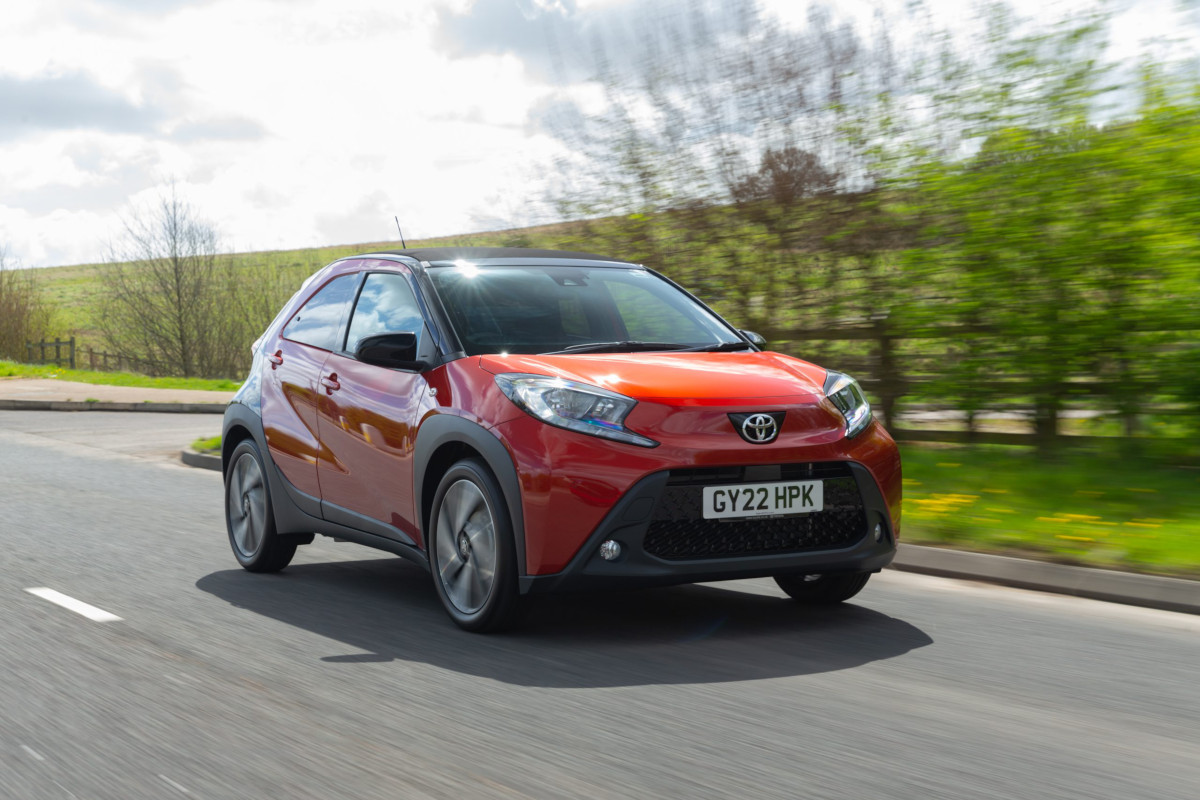
With this version of the Aygo, Toyota forged its own path. The C1 and 108 are no more, leaving the Aygo to become a pint-sized SUV: the Toyota Aygo X (pronounced ‘Aygo Cross’, if you were wondering, but not written out like the larger Yaris ‘Cross’ SUV).
Despite its funky off-roader-alike design, the Toyota Aygo X remains strictly front-wheel drive, so if you want to head off the beaten track in a tiny 4x4, you’ll need a used Fiat Panda 4x4 or Suzuki Ignis Allgrip. There’s also just one engine option: a naturally aspirated 1.0-litre three-cylinder petrol with 71bhp. Unlike the newer Aygo X Hybrid introduced later, this generation offered no hybrid or electric alternative.
It’s also quite pricey for a city car. Entry-level versions cost more than a basic Kia Picanto, while top-spec models crept into the price territory of larger superminis such as the Volkswagen Polo or Skoda Fabia. Offsetting that, to some extent at least, are generous levels of standard equipment. It’s also significantly cheaper than small electric cars such as the Fiat 500e, and faces stern competition from the newer Fiat Grande Panda.
It’s worth noting that this version of the Toyota Aygo X was sold between 2022 and 2026. It’s since been replaced by an updated car with a new front end design – and, crucially, a hybrid automatic powertrain. This gives more power, better drivability and, incredibly, even better fuel economy. It does, however, take the price point even higher…

How practical is it?
At 3,700mm long – barely three-quarters the length of a Range Rover – the Aygo X has got five doors, room for four (including adults in the rear seats so long as you’re not planning long journeys) and even a decent-sized boot. That’s largely down to the fact that it’s 24 centimetres longer than the old Aygo, but is still impressive.
Boot space is 231 litres. That’s a little short of the Hyundai i10, one of its closest rivals, but it’s 60 litres more than you got in the old Aygo. And when you fold down the rear seats, you get 829 litres of luggage space.
That said, you can’t entirely beat the laws of physics. The narrow rear door aperture is frustrating, especially if you want to put a child seat back there, and there’s not much room once you’re inside. At least you’ll only need to accommodate two passengers; some rivals squeeze in a third seatbelt, but space is extremely tight when they do.
Up front, there are more ‘normal’ levels of space, though the relatively narrow width of the cabin means that broader-shouldered occupants might feel a little close to one another. This narrowness is also reflected in the dashboard layout: there are only two air vents, positioned at the far left and right, with none in the centre.
What's it like to drive?
Despite weighing less than half as much as a Land Cruiser – the largest Toyota SUV you can buy – the Aygo X’s acceleration isn’t exactly explosive. In fact, with only 71bhp available, it takes 14.9 seconds to get from 0-62mph. A Hyundai i10 feels much perkier.
On dual carriageways and motorways, you have to work the naturally aspirated 1.0-litre engine hard to keep up with traffic, and you may well have to change down a gear or two to tackle steep hills. Revving the engine out is quite a noisy experience, too. This is not a car for relaxed motorway cruising.
The upside to that lightweight design and small engine, though, is that it feels impressively agile. It’s keen to change direction, the steering is lightweight but very precise and there’s surprisingly little body lean. That being said, the short wheelbase combined with a relatively wide track (the width between the left and right wheels) means the front end doesn’t always bite into corners quite as eagerly as you might expect.
The short-throw gearshift is well positioned and has a sweet feel to it – which is just as well because you’ll find yourself changing gears frequently in the manual version. The clutch is light, too, but that means it can be hard to find the biting point. And we’d prefer a six-speed gearbox rather than the Aygo’s five-speed manual.
The ride, meanwhile, is pretty firm, but it’s more comfortable, composed and less fidgety than you would perhaps expect from such a small car. The short wheelbase does make the Aygo a little susceptible to buffeting from crosswinds, however, and it doesn’t always deal brilliantly with potholes.

Technology, equipment & infotainment
Equipment is arguably the Aygo X’s trump card. There are some genuine ‘big-car’ features fitted as standard even on entry-level trims. These include lane-keep assist, adaptive cruise control, automatic emergency braking and a reversing camera.
All models also get a central touchscreen infotainment system that’s either seven inches, eight inches or nine inches in size – effectively the same setup used in larger Toyotas like the Corolla or RAV4. And although the graphics aren’t the sharpest or most modern-looking, it’s still impressive for a car in this class.
Regardless of screen size or trim level, all versions support Apple CarPlay and Android Auto. In top-spec models, the smartphone mirroring is wireless, too. Every Aygo also gets a small, neatly styled driver’s display, which allows you to toggle through various bits of info about the car, your music or which safety systems you’ve got running.
Mid-spec Edge trim adds climate control air-con, automatic wipers, automatic LED headlights with high-beam assist and 18-inch alloy wheels. Top-spec Exclusive cars come with keyless entry and part-faux-leather front seats, plus the option to add a sliding canvas roof or an upgraded JBL stereo system.
Toyota also introduced several special editions during the Aygo X’s lifespan, including the JBL with upgraded audio and styling tweaks, plus the Undercover collaboration model with unique cosmetic details. Both were considerably more expensive than the standard versions and, given the extra equipment, are worth seeking out on the used market if you want something more distinctive.
In quality terms, the plastics aren’t quite up to Volkswagen standards, but they’re not bad for a budget city car.

Toyota Aygo X running costs
Running costs are a real strength, given the Aygo’s ability to consistently return better than 50mpg, no matter how much you rev it. In fact, its official fuel economy of 58.9mpg seems quite achievable if you’re careful. However, that’s when we’re talking about the manual Aygo X; the CVT automatic manages 56.5mpg in the official WLTP fuel economy tests.
What’s more, you have to work the little engine so hard on faster-flowing roads that we’d sacrifice a little extra fuel economy for a more peppy performance out of town.
That said, the Aygo X does manage to slot itself into a slightly lower company car tax bracket than the 1.0-litre Hyundai i10, so there is a cost advantage for those planning to run one as a company car. Insurance should also be relatively affordable compared with larger or more powerful alternatives. Most versions of the Aygo X sit in low insurance groups (typically group six), which should make premiums manageable for younger drivers or those looking to keep costs down.

Toyota Aygo X reliability
This is where Toyota tends to shine. The brand has long enjoyed a strong reputation for building dependable cars, and the Aygo X appears to follow that pattern. In the 2025 What Car? Reliability Survey, Toyota finished an impressive fourth out of 30 manufacturers. The Aygo X itself performed even better, finishing second in the small car category with a near-perfect score of 99.7%, beaten only by the Hyundai i10.
In terms of warranty cover, Toyota now offers a three-year manufacturer warranty that can be extended annually under its Toyota Relax scheme, provided the car is serviced at a Toyota franchised dealer. With that proviso, cover can continue for up to 10 years or 100,000 miles. It’s one of the most generous warranty packages currently available, and reassuring if you’re planning to keep your car for the long-term.
- There are neat little weight-saving and cost-saving touches all over the place in the Toyota Aygo X, such as the all-glass rear tailgate, which has been an Aygo signature since the 2005 original. Altogether, they add up to an impressively low kerb weight: as little as 945kg in base specification.
- Despite being a five-door car, the rear windows don’t wind down either manually or electrically. Instead, there’s a simple pop-out latch – the sort of thing once common on bargain-basement three-door hatchbacks. With climate control or air conditioning on all models, it’s not really an issue, but it does show where Toyota has been saving costs – and weight. More frustrating is the lack of one-touch operation for the driver’s window switch, which can definitely be a source of frustration at car park barriers or drive-throughs.
- Entry-level cars get 17-inch alloy wheels, but the mid-level Edge and up have 18-inch rims. That sounds like it ought to look ridiculously over-wheeled, but actually the visual effect is nicely balanced. They’re fitted with quite narrow 175-section tyres, though, which helps with the Aygo’s fuel economy and emissions.
- Since there’s only one powertrain choice, there aren’t that many options to go through, but we would recommend the manual gearbox over the CVT automatic. The manual is slick, and easy to use, while the automatic CVT is a type of gearbox that makes an already intrusive engine note even more insistent, because of the way it revs when you’re accelerating. The manual car is also more fuel-efficient than the auto.
- If you’re looking for the best trim level, we reckon the mid-range Edge is the one to go for, balancing value for money with extra equipment. Pure-spec cars still get all the active safety systems we mentioned earlier in the review, but added kit such as climate control and auto wipers is welcome, while 18-inch wheels and two-tone paint provide an extra visual kick.
- That said, the entry-level Aygo X Pure is still a decently equipped car, and definitely represents good value for money if budgets are tight.