It’s the news that many of us have been waiting for for a long time: buttons are making a comeback in car interiors. Yes, real buttons that you press. Switches you flick. Dials you turn. The wholesale shift to touchscreen-based controls appears to now be going in reverse. (Some) car makers are launching new models with more – not fewer – buttons than before. Could this be the beginning of the end for the touchscreen and a return to a more tactile way to interact with our cars? Let’s dig a little deeper.
How the touchscreen took over
We’ve all got used to using touchscreens over the past few years. Whether it's our phone, tablet or even our cooker, most of us are used to swiping and tapping at a screen to get things done. Increasingly, this has also become how we interact with our cars.
Almost every new car launched in the past decade features an iPad-like touchscreen in the middle of the dashboard. Many functions that used to require just the push of a button or the twist of a dial now require you to scroll through seemingly endless icons and menus on a screen.
In-car touchscreens have been around longer than you might think, though. They started appearing on luxury models in the late 1990s (Lexus was a pioneer), although at this point they were used only for navigation or audio functions. As the technology developed (and got cheaper), screen sizes got larger and more functions were added. Even so, by the early 2010s, the largest were usually only 7- or 8 inches, and most existed alongside physical controls. But then came the car that changed everything: the Tesla Model S.

Introduced in 2012, it featured a huge (17-inch) portrait-format touchscreen that controlled just about every function. Even by today’s standards it’s an impressive bit of kit. Back then, it looked like exactly what it turned out to be: the future.
Some people voiced concerns about how distracting the Model S’s screen could be, but suddenly, every other car interior looked antiquated. Unsurprisingly, other car brands couldn’t develop their own versions of the Tesla mega-screen quickly enough. The floodgates had opened and a tsunami of touchscreens followed.
Why buttons got the boot
Moving most of a car’s controls to a touchscreen had clear benefits for car makers. The most obvious was cost, because a single slab of glass and a bit of software is a lot cheaper to produce than bespoke buttons and switches (and wiring) that need to be designed, tested and fabricated.
Touchscreens allowed new tech features to be added, without the need for extra switches, and they made it easy to integrate apps such as Apple CarPlay and Android Auto.
Remember, too, that by this time the smartphone had become central to daily life, so everyone was already familiar with prodding, swiping or pinching a screen. And, last but not least, touchscreens were the ‘in thing’. They looked sleek and futuristic and, well, y’know, everyone else was doing it.
The backlash
From the start, many of these systems were criticised in the media for not being especially user-friendly. And not all car buyers were happy about the change. Online forums and owner reviews were (and still are) full of rants about fiddly, unresponsive touchscreens that – let’s face it – no-one actually asked for in the first place.
Volkswagen came in for a lot of criticism, perhaps because it’s known for its sensible – rather than faddish – interiors. Or it was. Because VW jumped on the touchscreen bandwagon harder and more quickly than most. In quick succession it rolled out the first of its new ID range of electric cars, the ID.3, and the Mk 8 Golf, both of which featured prominent touchscreens and a bare minimum of physical controls. Even those that remained on the steering wheel were ‘haptic panels’ rather than actual buttons that clicked on or off.
At the time, Volkswagen said: “In a world where complexity is ever-increasing, the new Golf allows the driver to operate the vehicle intuitively.” But many drivers disagreed, complaining that the software was laggy and the controls were fiddly.
Eventually, VW backtracked. An update in 2024 saw the steering wheel controls in both cars swapped for ‘proper’ buttons. Then, in 2026, VW revealed the interior of its new ID.Polo, which will influence its next generation of models. Yes, it still has a touchscreen, but beneath it is a row of large, conventional buttons for the air-con controls. Big, clicky buttons that you can’t miss. There are more on the steering wheel and even an old-fashioned rotary dial for the volume control. Thomas Schafer, CEO of Volkswagen Passenger Cars, said, “We’ve completely redesigned our cockpit architecture based on customer feedback. It was important to us to focus on intuitive operation, including physical buttons.”

VW’s mea culpa isn’t the only one, because other brands have committed to retaining or reintroducing physical controls. Every Polestar to date (the brand has only existed since 2017) has been touchscreen-only for its main controls. In May 2026, however, CEO Michael Lohscheller said: "We do listen to customers... They say ‘we want more buttons’. It’s that simple. And yes, we will do buttons."
Hyundai Design North America Vice President Ha Hak-soo, meanwhile, told the Korea JoonAng Daily in 2024 that the brand had ‘tried out touchscreen-based controls’ but that ‘people didn’t prefer that’. Sure enough, when Hyundai updated the Tucson in 2024, it added – rather than took away – buttons.
In truth, Hyundai and sister company Kia have never gone down the screen-only route, retaining some physical controls for most of their models. Plenty of other brands have kept switches or dials for main functions, too, including Citroen, Dacia, Honda, Renault and Toyota. Admittedly, many long-running models have retained physical controls because that’s what they were engineered for in the first place, but for some brands it simply seems like a case of sticking with what works.
Interestingly, many high-end cars still have physical controls too. Most Bentley and Rolls-Royce models have an array of traditional-looking knobs and dials beneath the obligatory touchscreen, perhaps reflecting not only the financial value of physical controls, but also their tactile appeal.
The safety debate
The ‘touchscreen vs buttons’ debate is about more than just the frustration of having to scroll through a load of sub-menus to find your favourite radio station, of course: it’s about safety. And various studies suggest that touchscreens can be a major distraction for drivers.
In 2022, for example, Swedish magazine Vi Bilägare ran a real-life test of 12 cars and found that the time taken to perform four simple tasks was just 10 seconds in a touchscreen-free 2005 Volvo V70, but 44.9 seconds in an MG Marvel R with a large touchscreen.
A 2025 study by the University of Washington and Toyota Research Institute, meanwhile, concluded that participating drivers drifted side to side in their lane 42% more often when interacting with a touchscreen.
But most of us realise that the physics of looking at a screen and finding the right icon or menu requires a lot more attention than simply reaching out for a dial that we’ve used hundreds of times. And let’s not forget that safety concerns are why precisely using a mobile phone while driving has been illegal since 2003.

The realisation that removing buttons can have safety implications has prompted new regulations. From 2026, Euro NCAP has introduced new criteria for the ‘placement, clarity, and ease of use of essential controls’. It will now deduct points from a vehicle's safety rating if it doesn't have physical switches for the turn signals, horn, windscreen wipers and emergency calls.
New legislation planned by China’s Ministry of Industry and Information Technology goes even further. Due to come into effect in July 2027, it would make manual switches for gear selection, driver assistance features, the windscreen defroster and on/off switch a legal requirement for new cars sold in China. Small steps, perhaps, but a tangible change that's likely to affect the development of future models from most car brands.
Finding the right balance
The re-introduction of traditional physical controls to cars does seem to be more than just a fad. Car touchscreens are most likely here to stay, for the reasons we covered earlier. But it seems that, increasingly, they’ll complement – rather than replace – traditional buttons and switches.
Buyers and safety experts have spoken. Car makers have listened. And if you want a poster child for the ‘bring back buttons’ movement, how about the Ferrari Luce? The Italian brand’s new electric car, due on sale later in 2026, is its most forward-looking yet and, beneath a small touchscreen, it has a row of beautifully crafted, decidedly old-school toggle switches. Designed by Jony Ive of Apple fame, no less.
So it could be that the designer partly responsible for the iPad, and all the lookalike car touchscreen systems that followed, also plays a part in, if not their demise, then at least something of a demotion.
Four cars flying the flag for buttons
 Honda Civic
The latest Civic (on sale since 2022) has one of the best interiors of any Honda model for years. Simple and classy, it features a modest 9.0-inch touchscreen that has a physical rotary volume control knob that protrudes from one corner. Beneath it is one of the most user-friendly sets of manual air-con controls – a mixture of dials and buttons – of any new car.
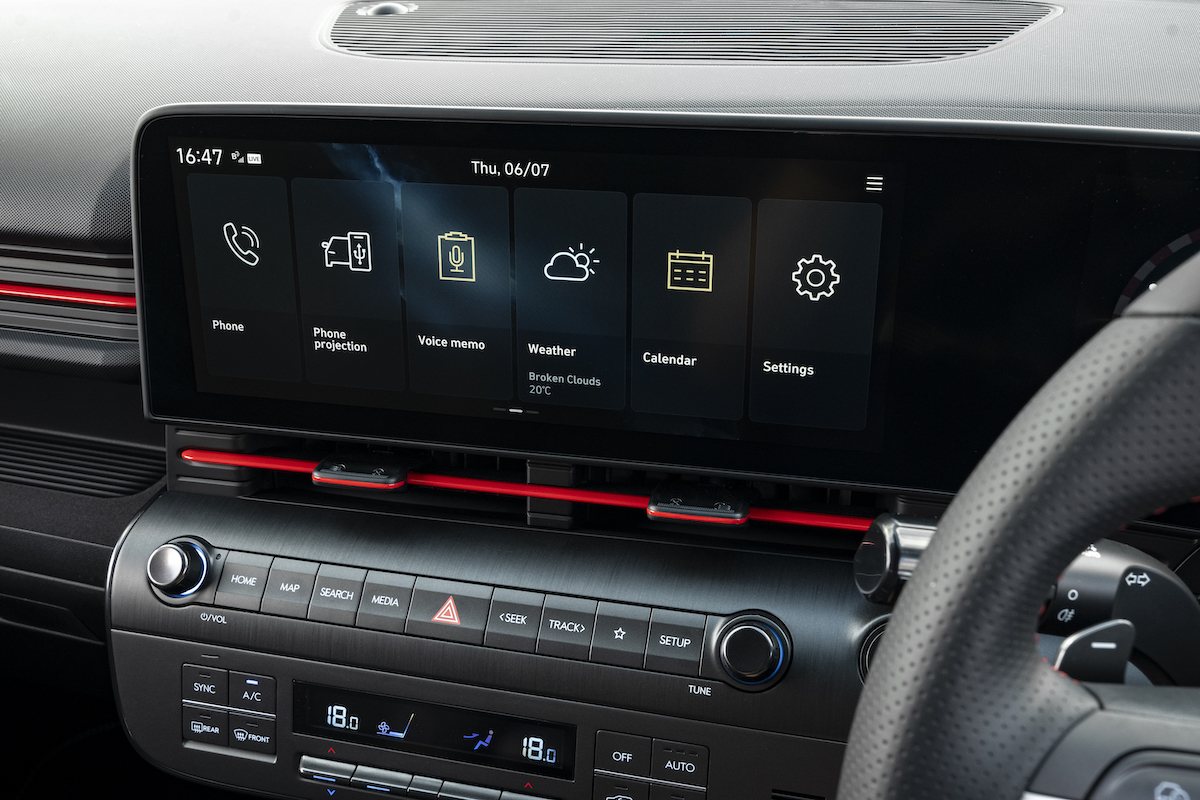 Hyundai Kona
Given its futuristic-looking exterior, you might think the latest Hyundai Kona would be a button-free zone inside. But you’d be wrong. Yes, there’s a sleek dual-screen digital display. But, depending on spec, there are also at least 20 buttons on the dashboard, with separate controls for the heating and various other functions.
 VW ID.Polo
After years of criticism for its ‘haptic’ controls, sliders and laggy touchscreens, Volkswagen has returned to something more sensible for its new range of models. The ID.Polo’s interior combines a touchscreen featuring big, bold icons with big, bold physical switches on the centre console and steering wheel. And it’s just the start. The updated ID.3 (now called the ID.3 Neo) has a similar layout, while other VW Group models look likely to follow suit, if the new Skoda Epiq is anything to go by.
 Ineos Grenadier
Can you have too many buttons? Ineos clearly doesn’t think so. The Grenadier’s button-strewn interior looks more like that of an aircraft than a car. As well as chunky manual controls all over the centre console, there are many more again on the ‘Overhead Control Panel’ in the rooflining. As with most aspects of the Grenadier, it’s all optimised for off-road use, the thinking being that you can still operate the controls while wearing gloves or bouncing along a rough track.